Sunday, 24 April 2016

No Bamboo Banawing!


On a recent visit to the Konkan Bamboo and Cane Development Centre (KONBAC) at Kudal, I came to know that there has been a drastic change in strategy to promote bamboo as construction material. Rather than endorsing bamboo as an affordable material for the poor, especially to build cost-effective houses, it is now being popularised as a material that satisfies the upwardly mobile elites’ fad of sustainability. Although the desire to replace unsustainable materials is laudable, the question is whether these projects, using bamboo, are truly as sustainable as they claim to be? Moreover, there also arises an issue of appropriation of material culture, especially of the poor in tribal areas by the dominant elites.


One of the strongest criticisms of the appropriation of the architecture of the poor has been made by the sociologist Anthony King, who writes that the rich often appropriate the architecture of farmer’s cottages (farmhouses) for their vacation homes (which are usually their second or third home). These elites, King observes, only absorb the aesthetics of a farmer’s house and not their lifestyle. The problem of the cultural appropriation of marginalized cultures without assimilation of the marginalized population seems to be prevalent everywhere. Raising the issues of cultural appropriation of hairstyles is a recent video titled Don’t Cash Crop on My Cornrows by Amandla Stenberg. There are many similarities between hairstyle and architecture. Both are about identity, and clearly about style. In so many ways, hairstyles are, in fact, a form of architecture. Stenberg’s major criticism is that white Americans love black culture more than they love the black people.The video demonstrates how hip-hop and pop have been appropriated from African American culture especially in terms of hairdos such as pleats, cornrows and so forth, while continuing with the racist hatred towards black people. These hairdos, as Stenberg notes, are ways in which black hair is kept from knotting. Stenberg laments that while these hairdos are stereotypical of the community, when white Americans adopts them, they turn into high fashion. This is a similar way in which vernacular architecture gets appropriated when architect claim them as ‘contemporary-vernacular style’. While the rich appropriate the poor farmer’s cottages to model their vacation-homes, these houses are always fitted with appliances and systems (air-conditioning etc.) needed for the comfort of upmarket modern living, which the vacationers cannot do without. Additionally there is also a failure to acknowledge the role of vernacular people, the ones who have championed the use of sustainable materials and forms in the first place.


In his book, The System of Objects, Jean Baudrillard argues that a suburbanite who aspires to move up into a higher class usually does so by buying antiques – symbols of old social position brought with new money. Essentially, he argues that the upwardly mobile class signal their social standing through material signs such as antique furniture, works of art, and so forth. Today, it is materials like bamboo that are being pressed into the service of consumption, because they give the image of sustainability. Using bamboo is fast becoming fashionable as appearing sustainable can symbolize that one has truly arrived in the elite world. Bauldrillard further discusses that every object has two functions – to be put to use and to be possessed. While a plastic chair in a living room can be put to use, it never seem to be dearly possessed, whereas the antique voltaire, may at times not even be used but is dearly possessed as an object. The argument for the bamboo is similar. The rich use it in an attempt to possess it as an object rather than utilising it functionally. It seems that the dominant cultures intermittently stoop to peripheral ones in order to appropriate from them, without the guilt of further marginalizing them. The violence is doubled as the poor are made to believe that there is legitimacy in the marginalized culture only when there is a sanction of it by the dominant ones.

The use of bamboo as ‘sustainable’ material in the construction of elite houses is also problematic because of the cost and distance of procuring it, as it is usually not locally available. Holistic sustainability has to factor in the ecological implication of transporting materials, plus the carbon footprint of the air-travel that the ‘designer’ architect would spend on travelling to the site. Moreover, even if sustainable material is used for the building of a second or third home, then the very idea of sustainability is defeated because sustainability has to be about satisfying only the primary needs of living and not about luxury.

It is not that architects and clients should completely ignore bamboo as a sustainable building material. In fact, organization like KONBAC have resorted to the marketing of bamboo to elites because there is no culture of building in bamboo in our society. Today, bamboo should not be a material of choice but that of convenience and compulsion. What is then required is a system of making bamboo easily available by creating a network of bamboo farmers, as KONBAC claims to have done. It is also important that the government create bamboo forests in close proximity to urban areas so that its transport from the source to the site is sustainable. Building in bamboo should not be about style but that of real ecological and social responsibility.

[This article first appeared on The Goan on 24th April, 2016]

Saturday, 26 March 2016

Namazgah: a Kafka-esque Castle

A recent newspaper report, ‘Bicholim’s Forbidden Namazgah’, brought back distant memories of the place. Bicholim is my mother’s birthplace, and as a child I spent many summers there. The Namazgah could be sighted from a distance, if one were seated on the right side of the bus while approaching the town, as I often did. Perched on a hill, the historic monument, which evidences Goa’s Islamicate heritage, always seemed like an intriguing place, one that I often yearned to visit as a child. Even now, between the monument and the town, midway along the hill, is a busy mining road where trucks full of ore ply from the mining areas to the river port. From a distance, these trucks seem like robotic guards to the Namazgah. The monument, because of its location and the restrictions surrounding it, reminds me of Franz Kafka’s novel The Castle, a haunting tale of a man who struggles relentlessly with an inscrutable authority to gain entrance to the castle.


During our school vacation days, the enigma of the Namazgah would frequently feature in our discussions; some older kids would boast of flying kites from there. Apparently, the kites flown from the Namazgah would disappear into the misty skies above the town. Such claims made a deep impression on me and I hoped to reach the hilltop someday.
I grew up in Vasco da Gama, the port town from which the ore mined from places like Bicholim is shipped to distant lands. My father worked for one of the mining companies, often driving from Vasco to Bicholim and back. When the mine company he worked for closed down, he was made redundant, and our family suffered in the process, just as many bahujan families do today.
I had to return to Bicholim to continue my education, partly because of these economic troubles. This is when the Namazgah became more accessible to me. I often climbed up the slopes of the hill to study in preparation for the 12th Board Exams. The place is a few minutes hike from my grandmother’s house. The hillside was tranquil, without a soul around, so one could read aloud. Also, I needed to move about while revising my lessons. This place provided multiple choices to study, including sitting on rocks; walking up or down the gentle slopes; or, if boredom was taking over, even running from one side to another, while screaming out some stupid chemistry formulae in order to better memorise them. I must have seemed like a fool to the occasional locals who came there to collect firewood. The side of the hill I studied on faces east, so after about 2 PM, it would turn shady.
Although I found the place relatively quiet, it was not as if the mining trucks had disappeared. They continued to ply across the belly of the hill, even having increased in number. The steady rumbling of the machines could put a baby to sleep.
In those days, the Namazgah merely appeared inaccessible, and people were not physically forbidden from visiting it as reported recently. The denial of access, for some time now, is because a huge mine lies across from the Namazgah. Although the hill as seen from the town appears normal, the western side is completely mined, with the excavations going extremely deep. The devastation is such that anybody seeing it from the Namazgah would justify the mining ban.

While I am skeptical of the appeals for a complete or immediate ban, I would like to argue that the recent mining ban in Goa had less to do with saving the environment and more to do with who benefits from mining. There is no denying that mining has been an important source of livelihood for many in Goa. A documentary produced by Time magazine in 1953, under its ‘March of Time’ series, suggests that mining made many prosperous then. In fact, the rise of the first Goan political bahujan leader Dayanand Bandodkar would not have been possible had he not been a mine-owner. That he was able to be Goa’s first Chief-Minister is a testimony to the power of mining as mediator of social change.
Apparently, the beneficiaries of the recent mining boom were largely the bahujans of Goa, many of whom were able to rise from the pits of poverty into a middle class life. This was because the benefits of mining were directly accessible to them. The rise of bahujans is apparently not easily digested, and one could read the mining ban as a systemic tool to weed the bahujans out from the business.
Given that we are on the cusp of resuming mining operations, the Namazgah will once again bear mute witness to the drone of machines. However, this time only a select few will benefit from the operations, while many bahujans dependent on mining will continue to live on the crumbs. As in Kafka’s tale, only some are allowed entry into the castle.
There is no doubt that mining has to be done in a different way – by ensuring that local communities benefit, that environment is minimally damaged (and then repaired as much as possible) and that heritage does not get obstructed or damaged.

[This article first appeared on The Goan on 27th March 2016, on the Easter Sunday] 


Sunday, 28 February 2016

To Plaster or Not


The Basilica of Bom Jesus needs to be re-plastered, without which it won’t survive for too long.

The Basilica of Bom Jesus in Old Goa is important not only because it houses the relics of St Francis Xavier, but also because it is a critical part of Goa’s architectural history. Apart from being a religious building, constructed between 1587-97, the Basilica represents the flowering of Renaissance style architecture in Goa.  


A generation of Goans has grown accustomed to seeing the Basilica’s exposed laterite walls, but this is not the way the building was designed, nor indeed the way it looked until about 60 years ago.  In his research paper, “On the Trail of Baltazar Castro, a Portuguese Restorer in India” (Proceedings of the EAHN 2015: Entangled Histories, Multiple Geographies, Belgrade), architect-scholar Joaquim R. Santos reveals that it was discredited restorer Castro who, in the 1950s, brought about the dramatic transformation of the external appearance of the Basilica, by having the plaster removed and leaving the underlying laterite stone exposed. Santos claims that such de-plastering was a part of President Antonio Salazar’s nationalistic ideology, where monuments were falsely ‘restored’ to look ancient, or rather medievalised, to proclaim the antiquity of the Portuguese empire. Santos also adds that many such ideologically motivated restorations were initially undertaken in Salazar-ruled Portugal during the 1940s. Apart from the de-plastering of the Basilica, Castro also affected the removal of its pyramidal sloping roof which was over the bell tower. Today, these changes still haunt the Basilica.  Replying to the recent discussion in the media on plastering the church, the rector of the Basilica, Fr. Savio Baretto admits that “[t]he bell tower is a real problem during the monsoon. Maximum leakage takes place there” (The Goan Everyday, 10 Feb. 2016).
Source: Souza and Paul Album (Central Libray)


But despite the deterioration, Fr. Baretto and many others seem to be against the idea of re-plastering the Church. The Rector echoes a romantic appeal that “[m]ost of the Goans have been born to the sight of a red bricked [laterite] Church. Having it plastered will hurt the sentiments of the people of Goa more than anything. I agree with the fact [that] the church is deteriorating, but there must be more modern ways of preserving and improving the structure”.  The fact is that there is no better way to preserve the church other than plastering it. History also suggests that such sentiments are misplaced, because the Basilica was always meant to be plastered since the time it was built in the late sixteenth century. If the public affection in Goa for the Basilica did not dim, despite the removal of its plaster, why would it happen now when the result would be the protection of the Basilica.
In his book Whitewash, Redstone: A History of Church Architecture in Goa (2011), architectural historian Paulo Varela Gomes claims that the Bom Jesus is a “unique façade in the history of Christian architecture” (p.68). A closer observation of the façade will reveal that it consists of two kinds of stonework - the hard and intricately decorated Bassein basalt, brought all the way from the Bombay region, and the porous local laterite stone. Of these, it is the hard stone which is meant to be exposed and un-plastered. The story of the exposed stone in the Basilica’s design is more interesting than it appears. The design of the church, the construction of which began in 1587, was a modest affair, writes Gomes, and that around 1596 the complex (Casa Professa) was practically finished, with only its façade yet to be built. Gomes argues that there was a decisive shift from modesty to monumentality when the Jesuits decided at the last moment to have the Basilica’s façade built of pedra do norte (northern stone), that is Bassein basalt. This stonework is indeed exquisite and truly marks the uniqueness of the Basilica.  Discussing the lasting contribution of the Bom Jesus façade, Gomes declares that “it could have been the building that allowed Indian artisans to domesticate European architectural and ornamental vocabulary, to make it their own” (p.70). It is clear that it was the Bassein stone with its ornamentation which was to be seen in relief against the plastered and the whitewashed walls of the rest of the Basilica. 
Source: Souza and Paul Album (Central Libray)
The Basilica was already renowned for its aesthetics of exposed hard stone and whitewashed walls before Castro’s intervention. He seems to have followed the politically motivated aesthetics used in Portugal to justify de-plastering.  But, monuments which were de-plastered in Portugal were made of hard granite, which can withstand the vagaries of nature; the same is not true of Goan laterite.  A porous stone, laterite absorbs water by capillary action which leads to the soaking of the entire wall. The damage is therefore not restricted to the exterior surfaces alone.  


The fact that the exposed laterite walls of the Basilica have miraculously withstood the onslaught of the Goan monsoons since the 1950s should not make us complacent.  The same fate, Santos claims, was not accorded to the Arch of the Viceroys in old Goa. It was also de-plastered by Castro, and soon afterwards crumbled during a heavy monsoon storm. The arch which is visible today is the reconstructed version. The clerical authorities in the Archdiocese have to decide, therefore, if the current aesthetics of the Basilica are more important than the monument itself.

[This article was first publish on The Goan Everyday on 29/02/2016]


Sunday, 31 January 2016

The Ruins that are Not

A large crowd had gathered for the Western classical music concert at the remains of St. Augustine’s in Old Goa on 7th January, 2016. Was the gathering purely one whose purpose it was to witness a musical performance, or was the fact that it occurred at a historical location itself symbolic of something more? Or is it that the congregation in great numbers was a performance in itself, a gathering to assert Goan identity, which the place and the music is emblematic of.


The music concert was held in the Church of Our Lady of Grace which is a part of the Augustinian monastery built in late sixteenth century. The Church was vaulted single-nave, with inter-connecting lateral chapels and had two tower façade. Architectural historian Paulo Varela Gomes writes that the Augustinian church’s more enduring contribution, indeed ground breaking for the architecture of Goa, resided in its main façade: it was the first church in Goa with a two tower façade, a type normally reserved for Cathedral churches that only the Holy See had adopted. It seems, subsequently, practically all parish and convent churches would have two towers. The highly visible landmark, a 46 meter high tower, built in locally sourced laterite stone, once served as a belfry and formed part of the façade of a magnificent Church.

The entire site is in ruins today, and the remaining tower of the Church façade hints at the glorious edifice that once was. In the book Imperial Debris: On Ruins and Ruination (2015), its editor Ann Laura Stoler proposes two ways of understanding the concept of ruins. She writes that “[r]uin is both the claim about the state of a thing and a process affecting it. It serves as both noun and verb. To turn to its verbal, active sense is to begin from a location that the noun too easily freezes into stasis, into inert object, passive form” (p.11). There is no doubt that St Augustine’s Church has achieved far greater fame because it is a ruin (as a noun). In many ways, the surviving tower is also symbolic of what remains of the once dominant Catholic culture. Stoler suggests that ruination is more than a process that ends up with building debris as a by-product. As per her, ruination is also a political project that lays waste to certain peoples, relations, and things that accumulate in specific places. The aftermath of such ruination invites visits by archeologists, art and architectural historians and, at best, tourists, notes Ronald Schulz, in his review of the aforementioned book published on H-Empire (February, 2015). In effect, then, ruins are rendered monumental, fossilized in time. There is something similar happening to colonial architecture in Goa as much as to the Goan Catholic culture it represents - both have become objectified in the way in which people from the rest of India look upon them through a touristic gaze, as if the place and its people were in a museum. 

It is here that I find Stoler’s concept useful, that “[t]o ruin [as a verb]…is to inflict or bring great and irretrievable disaster upon, to destroy agency, to reduce to a state of poverty, to demoralize completely" (p.9). The events that are unfolding in contemporary Goa seem to suggest that the Goan Catholic community is subjected to ruin through the undermining of its agency. This is because the dominant Brahmanical culture problematically characterizes Goan Catholic communities as native-managers and the sole beneficiaries of the erstwhile Portuguese colonial order, which in turn marks them as anti-national.  The Catholic community that produced a unique identity for Goa is thereby made to suffer the sins of an imagined ‘imperial’ past where Portuguese colonialism is rendered as being no different from British imperialism. Accordingly, Goa’s history is reduced to a small blot, to an undifferentiated and righteous Hindu-Indian past that rescued itself from the clutches of evil imperial oppression.  

What is conveniently obscured is that the history of the Portuguese empire in Goa led to the emergence of a unique local culture which was epitomised by the development of church architecture. In his book Whitewash, Red Stone: A History of Church Architecture in Goa (2011), Paulo Varela Gomes asserts that churches after the sixteenth century had “far less Portuguese influence than one would be led to believe” (p.4). Architectural practice during the colonial period in Goa assimilated global ideas and elements to create a unique local architecture, Gomes asserts. More importantly, in participating in the Renaissance and the Baroque styles of architecture, Goans were also contributing to global architecture. This is to say, they were producing modern aesthetics in their buildings, and therefore fashioning themselves as enlightened world citizens. It is this cultural heritage that contemporary Goan Catholics continue to hold on to.


The large gathering of Goans at the Western classical performance at what remains of the Augustinian complex is an assertion that they have not given up on the markers of their culture, the monuments, as much as the music. For these reasons, St. Augustine’s cannot be classified as a ruin just yet; the site is still an active monument, even if only a part remains. 

[This article first appeared on The Goan Everyday on 31 January 2016]

Saturday, 2 January 2016

How to Read Monuments

In her lecture titled ‘The Introduction to Ancient History’, delivered in August 2014, historian Romila Thapar – current D. D. Kosambi Chair at Goa University– suggested that there is a conceptual difference  in imagining the past through historical monuments as compared to reading about them in historical texts.  ‘Texts’ are abstract concepts, she explained, which must be ‘read’, their meaning understood, and only then can one locate their content in the historical context. In comparison to such abstraction, historical monuments have physical presence which can be seen, touched and felt. But one cannot simply visit a historical location and expect to be enlightened by the experience. An architectural appreciation of monuments requires meaningful engagement with their history and context. It is here that a well-researched guidebook can make a difference. One such book relevant to Goa is the recently released Portuguese Sea Forts: Goa, with Chaul, Korlai and Vasai (2015), by architectural historian Amita Kanekar.
 In Goa, there seems to be a general disregard for, and the resultant mismanagement of, monuments, be they churches, temples, mosques or forts.  There are many reasons for this, including the failure to see architecture as symbolic of specific colonial history, which is a point I shall return to. In the meantime, I’d like to suggest that what might help fill this lacuna is well-researched and accessible information about these monuments.
 It is in this exact area that the Deccan Heritage Foundation, the publishers of Kanekar’s book, have identified their niche. They seem to bridge the gap between serious academic works and coffee table books, having commissioned established research scholars to produce popular guidebooks on the architectural heritage of the Deccan region. These books highlight the historical context of monuments while also being lavishly illustrated with photographs. This invariably helps in attracting readership, but also can help visitors to have a more informed engagement with the monuments.
Kanekar’s book is an effort to present a reliable historical narrative of the many Portuguese sea forts on the Arabian Sea coast of the Deccan, as well as the role of these structures in empire-building. This guidebook is not merely a pictorial one, but has a solid dose of history, both architectural and political, which helps the reader understand the role of these forts contextually.
In the introduction of the book, the author reminds us that “[t]he real Portuguese conquest was less of land than of sea-borne trade. Albuquerque is himself supposed to have reassured the Malabar ruler that the king of Portugal did not build forts to ‘take land’, but ‘to keep his goods and people secure’” along the coast (p.14). It is precisely because of the coastal nature of the Estado da Índia, that Goa’s cultural hybridity was further influenced. Kanekar points out that the Portuguese were never more than a small minority in the Estado enterprise. It becomes obvious, therefore, that most of those who manned the Estado ships, populated its towns, and fought in its armadas and militias, whether they were free or enslaved, might have been part-Portuguese, local Catholics, local non-Catholics, Deccanis, Bengalis or Asians and others of mixed backgrounds. This, Kanekar’s book posits, is still visible in the Luso-Arabic-East African-Asian traditions of the Roman Catholic communities living near forts of the erstwhile Estado today. Of the forts documented in the book, apart from those in Chaul, Korlai, and Vasai, the rest are located in Goa.
In terms of architectural appreciation, one of the important observations to be drawn from reading Kanekar’s book is that what sets the Portuguese sea forts of the Deccan apart is that they were designed with a special emphasis on geometry.  While speaking at the launch of the book in December at the Goa Arts and Literary Festival, George Mitchell, another architectural historian and member of the Deccan Heritage Foundation, informed the audience that the other forts in the Deccan were different from the Portuguese ones, as they had high walls that skirted around the group of internal buildings, without much emphasis on geometric design. The Portuguese sea forts on the other hand, evolved with a special emphasis on geometry, explains Kanekar. Forts are essentially architecture of walls - articulated, elaborated and reinforced for the purpose of defence. However, the arrival of cannons in the fourteenth century resulted in a change in the design of forts, originating during the Italian Renaissance. Along with an emphasis on geometry, there was now a greater use of earth ramparts, ditches, and earth slopes.  While appreciating the history of Portuguese forts that survive today in Goa and elsewhere, we must remember that they are distinctly European examples of offence and defence that were adapted for local conditions.
While the book is successful in describing the many forts it has featured in great detail, its limitation lies in the fact that it is a victim of its format as a guidebook. It is unable to give us the layered politics of forts in history, nor how these monuments (and other Portuguese period architectural heritage) are perceived by Goans in contemporary times. Take for example the way in which temples from colonial times have been completely modified or rebuilt as part of revisionist efforts to bring Goa in line with a perceived sense of an ‘authentic’ Hindu-Indian past. Where deliberate disregard allows for the erasure of history and its architectural markers, the vacuum is too readily filled with fabrications. Nevertheless, books like Kanekar’s are useful in underscoring the past in the face of dereliction.


[A version of this article appeared on The Goan Everyday on 03 January 2016]

Sunday, 6 December 2015

Car-Free City!


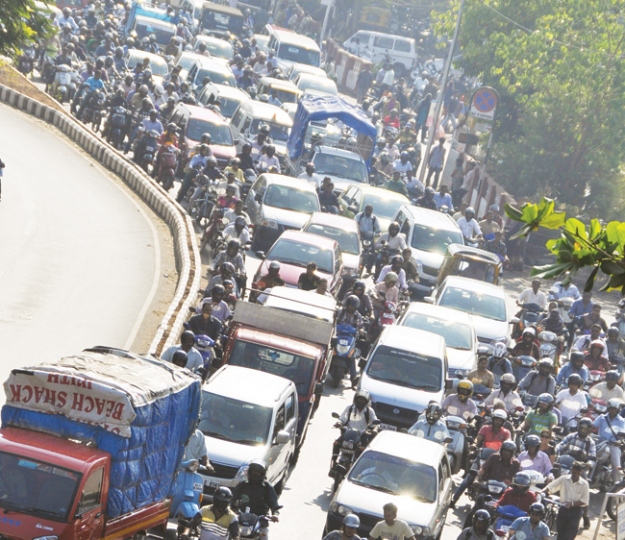
Indisciplined parking and a substantial increase in the numbers and sizes of cars have resulted in the choking of streets in most Goan cities. The result of which is that there is hardly any room for pedestrians. In Panjim, pedestrians have been further strained by the new plan for one-way vehicular movement, which has led to an increase in vehicular speeds, making it dangerous for pedestrians to cross roads. In ideal cities the pedestrians are supposed to rule the road, but in our cities they are forced to risk life and limb every time they step on the street.

 At a public consultation held by the City Corporation of Panjim (CCP) on 27 November 2015, to receive public feedback on Smart City proposals, Commissioner Sanjith Rodrigues recounted the problems the authorities face while implementing parking rules, despite employing contractors to clamp vehicles which flaunt these rules. An example he cited was of the no-parking area in front of the Caculo Mall in Panjim; some vehicle owners would apparently park their vehicles right in front of the mall, challenge the authorities to clamp them, proceed to have a meal inside the mall and, on their return, not only pay the fine but also offer an extra amount as a tip, and then drive off with glee. This vile kind of display of entitlement seems widespread in Goa nowadays.

Financial deterrents through fines are usually not adequate to discourage people from abusing the law (since the biggest law-breakers are usually the wealthy and powerful in any case!). But the efficient clamping by the contractor did help in bringing about some limited form of traffic discipline within the city. This, however, did not last long as the Panjim Councillors decided, a few months back, to dispense with the services of the said contractor (O Heraldo: 13 Aug. 2015). The city representatives probably succumbed to the pressure applied by elite vehicle owners and high-end shopping patrons. As a result, unlawful parking, whether in front of Caculo mall or other parts of the city, continues unabated and engaged in by many more.

The elite car owners dislike being ‘policed’ by ‘ordinary’ clamping workers or police constables, even if they have the money for the fine. So, even when their cars were parked illegally, many vehicle owners would abuse these workers who were simply doing their job.  This desire to flaunt one’s power and privilege by flouting the rules is a typical structural problem which emerges from the graded hierarchy of the caste system, where the privileged are always assumed to be right even when they are legally not.

The historic character of Goan towns is their compact built environment.  Widening of streets to accommodate more cars is only going to destroy this unique character. Moreover, widening of roads to ease vehicular traffic is a vicious cycle: the wider the roads, the more the numbers of cars, leading to more traffic jams. Bangalore is an excellent example of a city which has lost its character because of rampant road widening and innumerable flyovers. Despite these technological interventions, however, the time taken to get from one place to another has not reduced; on the contrary the opposite has happened. To make matters worse Bangalore’s pedestrian life has been completely compromised.

Given this situation, rather than discussing how to make more space for individually owned cars,  citizens must debate how to make the city free of them. In his article End of the car age: how cities are outgrowing the automobile (The Guardian: 28 Apr. 2015), Stephen Moss argues that cities around the world are coming to the same conclusion: they’d be better off with far fewer cars. In order to achieve this, the city needs to adopt a vision in which residents no longer rely on their cars but on efficient and respectful public transport.


The citizens of Panjim, who are discussing how to make their city smart, need to make some tough decisions, without which the city will soon come to a grinding halt. There is an urgent need to expel the cars from the city and make way for efficient public transport, cyclists and pedestrians. One great example we can learn from is the case of Amsterdam. Journalist Renate van der Zee (The Guardian: 5 May 2015) writes that although cyclists rule in the Dutch capital today, great pains had to be taken initially to accommodate them. Zee argues that it was because of the tough decisions taken in the 1970s that contemporary Amsterdam (or for that matter the whole of The Netherlands) is equipped with an elaborate network of cycle-paths and lanes, so safe and comfortable that even children and elderly people use bikes as the easiest mode of transport.

It is time for Panjim to go the Dutch way. World-over, more than the technological infrastructure installed by experts it is the actions of inspired citizens that make a city smart. It is only thanks to fierce activism, writes Renate, that Amsterdam has succeeded in becoming what it is, now: the bicycle capital of the world. The smart city, then, is really about wise citizens, who canvass for the right kind of smart systems.

(This article first appeared on The Goan Everyday on 6th Dec. 2015)

clip